Latest Updates
Toll free: 1-800-212-3001 Apply online Pay online




Blog
Blog
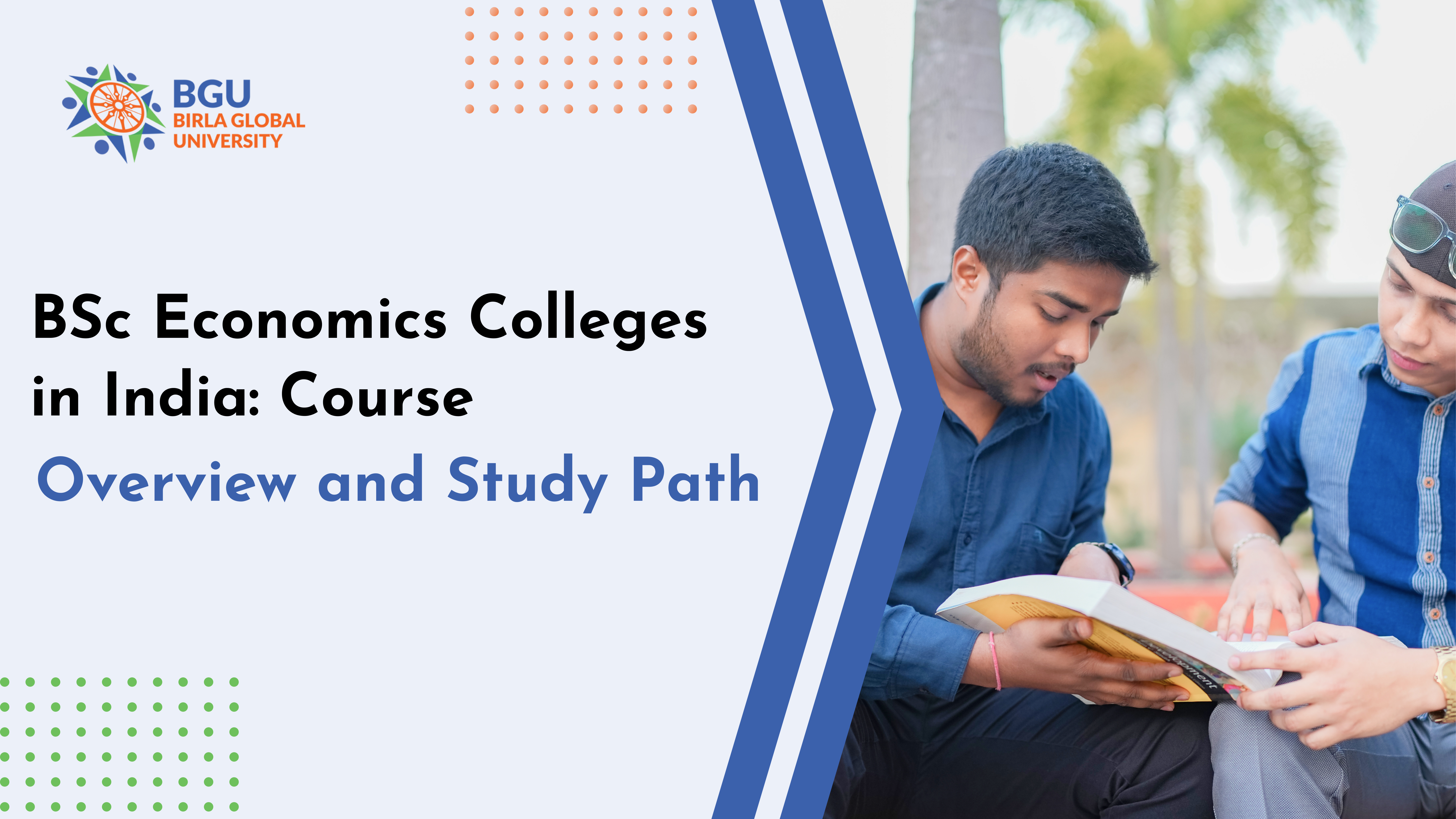
Economics plays a central role in understanding how societies function, how markets operate, and how public policy shapes development. As India continues to grow as a major global economy, the demand for professionals trained in economic analysis, data interpretation, and policy evaluation is steadily increasing. For students interested in understanding economic systems, financial markets, and public policy, pursuing a Bachelor of Science in Economics is a strong academic starting point.
Among the many undergraduate economics courses available in the country, BSc Economics has gained recognition for combining theoretical learning with analytical and quantitative approaches. Students explore economic principles alongside mathematics, statistics, and data analysis—skills that are increasingly valuable in modern careers.
Many BSc economics colleges in India offer well-structured programmes designed to help students build a strong academic foundation before progressing to advanced study or professional roles. Institutions such as Birla Global University are part of a growing group of universities that focus on interdisciplinary learning, research exposure, and real-world economic analysis.
This article explores the structure and purpose of a BSc Economics programme in India, including entry requirements, key subjects, academic progression opportunities, and the long-term scope of this degree. It also explains what distinguishes the best colleges for BSc economics in India and how students can plan their academic journey after completing the programme.
Economics is one of the most versatile academic disciplines because it intersects with business, public policy, finance, and global development. At the undergraduate level, the subject introduces students to the fundamental principles that govern production, distribution, consumption, and resource allocation.
Students typically begin studying economics through foundational courses that explain how individuals, firms, and governments make decisions under conditions of scarcity. This foundational understanding is essential for analyzing economic challenges such as inflation, unemployment, trade imbalances, and sustainable growth.
An economics degree after 12th allows students to begin developing critical analytical abilities early in their academic careers. Undergraduate economics programmes emphasize several key skills:
These abilities are valuable not only in academic research but also in industries such as finance, consulting, government policy, development organizations, and international trade.
Another important reason economics is widely studied at the undergraduate level is its interdisciplinary relevance. Economics draws insights from political science, mathematics, sociology, business management, and environmental studies. This integration helps students develop a holistic understanding of complex social and economic systems.
Students who choose BSc economics in India often benefit from a curriculum that combines economic theory with quantitative methods. This scientific approach distinguishes BSc Economics from other undergraduate economics degrees, as it places greater emphasis on mathematical modelling, statistical tools, and econometric techniques.
Studying economics also encourages students to understand real-world challenges such as poverty reduction, sustainable development, and financial stability. By analysing national and global economic trends, students develop a deeper awareness of policy debates and economic decision-making processes.
Ultimately, the purpose of undergraduate economics education is to equip students with analytical frameworks that help them understand how economies function. This knowledge forms the foundation for advanced academic study and a wide range of professional opportunities.
Admission to BSc economics colleges in India typically requires students to complete their higher secondary education (Class 12 or equivalent). While the exact requirements vary by institution, most universities expect students to have studied mathematics at the school level, as quantitative skills are essential for the programme.
Most institutions require the following basic qualifications:
Some universities conduct their own admission tests, while others accept national-level entrance scores or merit-based selection based on academic performance in school examinations.
One of the advantages of pursuing BSc economics in India is that students from multiple academic streams can apply. Both commerce and science students are commonly eligible for admission, provided they meet the mathematical requirements.
Students from commerce backgrounds may already be familiar with basic economic concepts and accounting principles, which can help them transition smoothly into undergraduate economics courses.
Science students, on the other hand, often have strong mathematical skills that support the quantitative aspects of the programme. Since BSc Economics includes statistical analysis and mathematical modelling, this background can be particularly beneficial.
Some universities conduct institutional entrance examinations to assess applicants' aptitude in areas such as:
Other institutions may rely primarily on academic merit and personal interviews during the selection process.
Mathematics plays a crucial role in modern economic analysis. Students entering a BSc Economics programme should ideally have a strong foundation in algebra, calculus, and basic statistics.
These skills are essential because economic theories are often expressed through mathematical models. Students learn how to use equations, graphs, and statistical tools to analyse economic relationships and predict outcomes.
Students interested in b sc economics colleges in india can prepare by strengthening their understanding of basic economic concepts, mathematics, and analytical reasoning during their higher secondary education.
Reading about economic issues, following policy discussions, and exploring global economic trends can also help build interest and awareness before starting the programme.
The curriculum in BSc economics colleges in India is designed to provide a strong foundation in economic theory while also emphasizing quantitative analysis and data interpretation. Over the course of three years (or sometimes four in certain academic structures), students gradually progress from introductory concepts to advanced analytical techniques.
The programme typically combines lectures, tutorials, data analysis exercises, research projects, and examinations. Students learn to apply theoretical concepts to real-world economic problems.
Early semesters focus on core economic principles that explain how markets function and how individuals and institutions make economic decisions.
Key subjects usually include:
Microeconomics
This area studies the behaviour of individuals, households, and firms in economic decision-making. Students learn about supply and demand, market equilibrium, consumer behaviour, production costs, and competition among firms.
Macroeconomics
Macroeconomics focuses on the overall functioning of an economy. Topics include national income, inflation, unemployment, economic growth, fiscal policy, and monetary policy.
Together, microeconomics and macroeconomics form the backbone of economic analysis.
Because BSc Economics follows a scientific approach, mathematics plays a central role in the curriculum. Mathematical economics introduces students to mathematical models used to explain economic relationships.
Topics often include:
These mathematical tools allow economists to develop theoretical frameworks that explain complex economic behaviour.
Data analysis is an essential component of modern economics. As a result, most bsc economics subjects include courses in statistics and econometrics.
Students learn how to collect, analyze, and interpret economic data. Common topics include:
These skills are widely used in fields such as financial analysis, policy evaluation, and market research.
Development economics examines the economic challenges faced by developing countries. Students explore topics such as poverty, inequality, education, healthcare, and economic growth.
This subject is particularly relevant in countries experiencing rapid development and structural transformation.
Public economics studies the role of government in economic activity. Topics include taxation, government spending, welfare policies, and public goods.
Understanding these concepts helps students analyse how policy decisions influence economic outcomes.
International economics explores global trade and financial relationships between countries. Students study topics such as:
These topics are important for understanding the dynamics of global markets and international economic cooperation.
Many undergraduate economics courses incorporate research projects and term papers. Students learn how to collect data, conduct literature reviews, and develop research-based arguments.
These projects help students apply theoretical knowledge to practical economic questions.
With numerous BSc economics colleges in India, choosing the right institution is an important decision for students. The quality of faculty, curriculum structure, research opportunities, and industry exposure can significantly influence a student's academic experience.
The best colleges for BSc economics in India share several common characteristics.
Leading institutions design their curriculum to reflect modern economic research and industry needs. This often includes advanced courses in econometrics, financial economics, behavioural economics, and data analytics.
A well-designed curriculum balances theoretical learning with practical applications, allowing students to understand both abstract economic models and real-world economic problems.
Faculty expertise is a key factor that distinguishes top institutions. Professors who actively engage in research contribute to a vibrant academic environment and expose students to contemporary economic debates.
Research-driven institutions encourage students to participate in seminars, workshops, and collaborative projects.
Modern economics increasingly relies on quantitative analysis and data science. Leading universities incorporate statistical software, data analysis tools, and computational methods into their teaching.
Students gain hands-on experience working with datasets and economic models.
Many of the best colleges for BSc economics in India integrate economics with other disciplines such as business management, political science, public policy, and finance.
This interdisciplinary approach helps students understand the broader social and institutional context of economic decisions.
Top universities often provide opportunities for internships, industry interactions, and policy engagement. Students may gain experience working with financial institutions, research organizations, consulting firms, or development agencies.
Practical exposure allows students to apply classroom knowledge to real-world economic problems.
Libraries, research databases, computer laboratories, and statistical software are essential resources for economics students. Institutions that invest in these resources provide students with better opportunities for research and analysis.
Economics is inherently a global discipline. Leading universities encourage students to study international economic trends, participate in academic collaborations, and attend global seminars.
This global perspective helps students understand how economic policies and markets operate beyond national boundaries.
One of the major advantages of pursuing BSc economics in India is the wide range of academic pathways available after graduation. The degree serves as a foundation for advanced study in economics, finance, data science, and public policy.
Students who wish to deepen their academic expertise often pursue postgraduate programmes.
Many graduates continue their education by pursuing a Master of Science in Economics. This advanced degree focuses on deeper theoretical analysis, econometric research, and specialized economic fields.
An MSc Economics programme prepares students for careers in academic research, policy institutions, and economic consulting.
Because BSc Economics includes significant quantitative training, graduates are well prepared to transition into data-focused disciplines.
Postgraduate programmes in data science, statistics, or analytics allow students to apply their quantitative skills in industries such as technology, finance, and business intelligence.
Economics graduates interested in governance and social development often pursue master's degrees in public policy, development studies, or international relations.
These programmes focus on designing policies that address economic and social challenges.
Another popular option after an economics degree after 12th is to pursue business administration or management education. Graduates may enrol in MBA programmes to specialize in areas such as finance, marketing, operations, or strategic management.
Economics graduates often perform well in management studies because they already possess analytical and decision-making skills.
Graduates may also pursue professional qualifications in areas such as finance, accounting, and financial analysis.
These certifications provide specialized expertise that complements economic training.
Students interested in research may continue their academic journey through doctoral programmes in economics or related fields.
A PhD in Economics enables graduates to pursue careers in academic institutions, research organizations, and international economic agencies.
The scope after BSc economics is broad because the degree equips students with analytical, quantitative, and research skills that are valued across industries.
Graduates may find opportunities in fields such as:
Economics graduates are also increasingly valued in industries that rely heavily on data-driven decision-making.
In addition to employment opportunities, the degree provides a strong intellectual foundation for lifelong learning and research.
Economics is a discipline that provides powerful tools for understanding how societies allocate resources, respond to policy changes, and adapt to global economic shifts. For students interested in analysing economic systems and contributing to policy and development discussions, pursuing a Bachelor of Science in Economics offers a strong academic starting point.
The growing number of BSc economics colleges in India reflects the increasing importance of economic education in a rapidly evolving global economy. Through a combination of theoretical learning, mathematical modelling, and data analysis, the programme equips students with skills that are valuable in both academic and professional contexts.
Students exploring undergraduate economics courses benefit from an interdisciplinary curriculum that connects economics with finance, policy, mathematics, and statistics. This integrated approach helps them develop a deeper understanding of economic challenges and opportunities.
Choosing the right institution plays a crucial role in shaping a student's academic experience. The best colleges for BSc economics in India emphasize strong academic foundations, research exposure, and practical learning opportunities.
For students seeking an economics degree after 12th, BSc Economics offers a clear pathway to advanced academic study and diverse career opportunities. Whether students pursue postgraduate research, professional careers in finance, or roles in public policy and development, the knowledge and analytical abilities gained during the programme provide a strong platform for future success.
What is BSc economics in India?
BSc Economics is an undergraduate degree that focuses on economic theory, mathematical analysis, statistics, and data interpretation. It provides students with a scientific and analytical approach to studying economic systems.
Which are the best colleges for BSc economics in India?
Many universities and institutions across the country offer strong undergraduate economics programmes. The best colleges typically provide experienced faculty, research opportunities, and quantitative training.
What subjects are included in BSc economics?
Common BSc economics subjects include microeconomics, macroeconomics, mathematical economics, statistics, econometrics, development economics, public economics, and international economics.
Can students pursue MSc economics after BSc economics?
Yes, students can pursue MSc Economics after completing their undergraduate degree. This postgraduate programme allows them to specialize in advanced economic theory, econometrics, and policy analysis.
Is BSc economics suitable for commerce and science students?
Yes. Students from both commerce and science backgrounds can pursue BSc Economics, provided they meet the university’s eligibility criteria, particularly in mathematics.
