Latest Updates
Toll free: 1-800-212-3001 Apply online Pay online




Blog
Blog
The demand for journalism and mass communication courses in India has increased rapidly in recent years. As technology has advanced, students have increasingly chosen careers in digital media, TV, online journalism, advertising, and public relations. Such courses can help them learn skills in communication and reporting, as well as in creative thinking and technical abilities.
At Birla Global University (BGU), students in the Birla School of Communication undergo training through industry-based programs covering journalism, public relations, advertising, and digital communication. Birla Global University emphasizes practical media education through state-of-the-art production centers and industry-oriented training programs.
In modern times, college selection is not solely based on reputation. Students give more attention to practical training, placement options, faculty, and industries as well. A JMC program can help students build their career in various fields like journalism, film-making, public relations, and digital media among others.
This guide describes the process whereby students assess and choose journalism and mass communication courses in India. The manual further includes other relevant aspects such as the curriculum, admission requirements, practice sessions, and career prospects.
Journalism and Mass Communication is a course of study concerned with disseminating information to the masses through print, electronic, and social media, as well as television and radio. This subject involves aspects like creativity, communication, research, and technology. Students who wish to become storytellers, speakers, producers, or news reporters usually opt for this subject.
BGU’s Birla School of Communication provides courses like BA Journalism & Mass Communication (Hons.), MBA Communication Management, MA in Mass Communication, and Ph.D in Journalism & Mass Communication.
The main objective of JMC education is the training of students in media ethics, communication tactics, reporting, and creation of digital contents. Modern media studies programs also educate their students on how to cope with changing technology and new media.
The coverage area of media education in India has become vast because of the emergence of digital media platforms. Previously, journalism was associated only with print and TV mediums. Now, people who pursue careers in media have started working for podcasts, YouTubers, online news websites, social media marketing, and digital marketing. Students pursuing JMC courses gain knowledge in:
The BGU’s approach to teaching is through a “skill-driven, competency-based learning programme,” where the students gain hands-on experience in media production styles like news production, panel discussion, and digital broadcasting.
Media industry careers can be found in the conventional as well as the digital sector. Therefore, journalism and mass communication courses in India are quite appropriate for individuals seeking stimulating career prospects.
Career choices after graduation are one of the most important considerations that students take into account when deciding to pursue studies in JMC. This field encompasses diverse disciplines, which demand effective communication and creativity. Some of the careers students pursue include:
As mentioned by BGU, the students of the Birla School of Communication have been offered jobs in reputed firms like Burson, Ketchum, Adfactors PR, and Zee Entertainment Ltd with salaries up to INR 7 LPA.
The academic framework for JMC programs integrates theoretical education with practical learning. Learners are taught about various forms of communication, ethics in the media, reporting techniques, and the psychology of the audience. This framework aims at developing effective communication skills among learners.
According to BGU, the curriculum at their institution prepares the students for “today’s fast-paced media landscape” through academic knowledge and practical skills in the industry along with exposure to media. The syllabus of most universities which impart education in the field of journalism and mass communication in India is constantly updated according to the latest trends prevailing in the industry.
Most universities offering journalism and mass communication courses in India keep updating their syllabi based on the current happenings in the industry. This will ensure that the students are ready for the future.
JMC programs usually start with the principles of journalism. The students get to learn how information is gathered, fact-checked, and presented to the public. They are taught how to write factual reports in adherence to ethical codes. Key areas under journalism principles include:
The students are also aware of the significance of accuracy, objectivity, and good journalism. These basic subjects are vital to create a successful career in the media industry.
Communication is a significant aspect of any media-related profession. Hence, courses offered in media studies emphasize teaching students about the influence of communication on society and culture. Students study subjects such as:
These subjects are useful for gaining insight into the operations of media industries. BGU also provides an MBA in Communication Management, indicating the trend towards the fusion of communication and management.
Practical learning is one of the most essential elements in JMC education. The majority of students tend to like educational institutions that offer media experience in practical settings through internships and media labs.
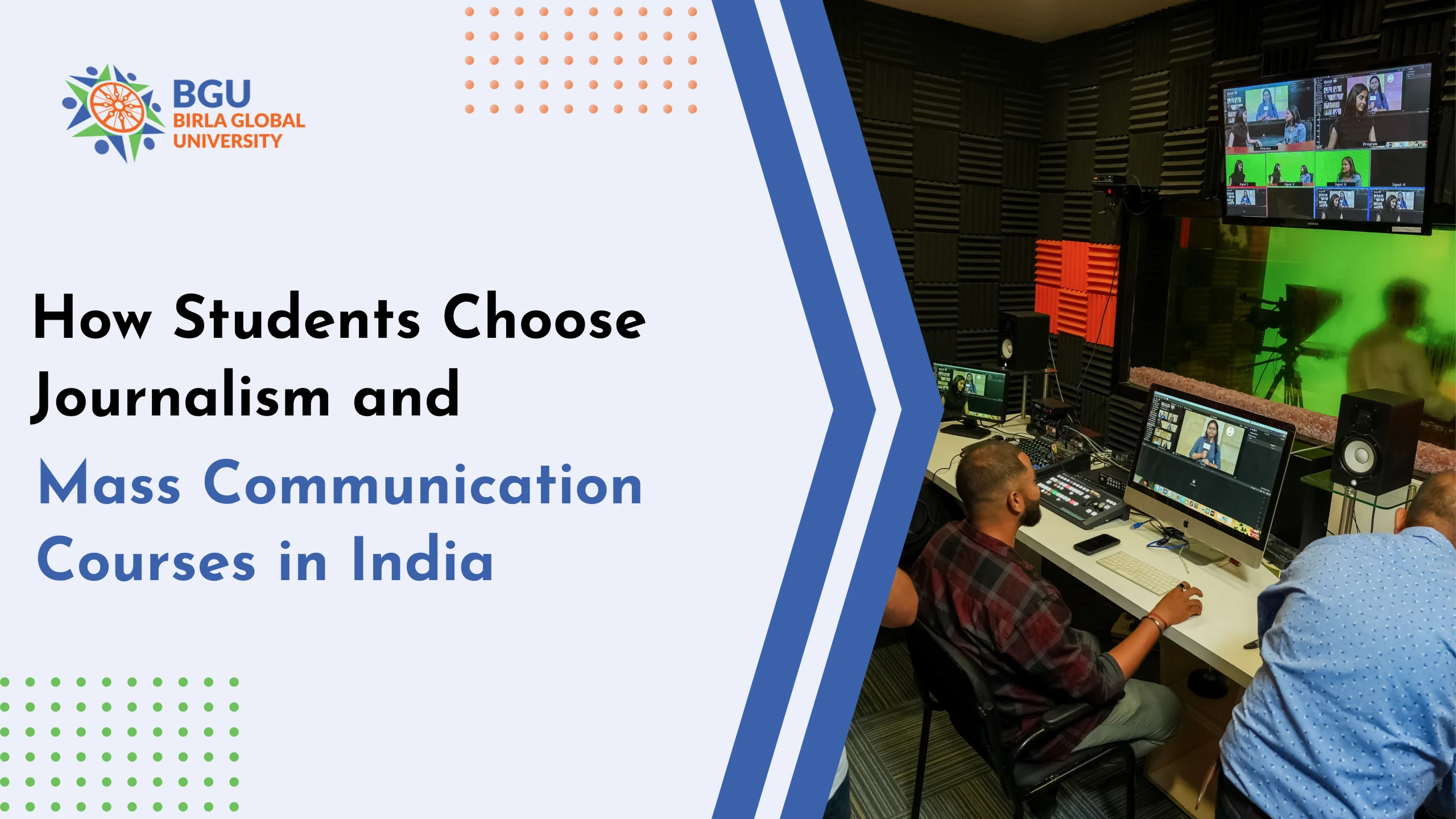
One of the main reasons why students choose to study at the Birla School of Communication at BGU is due to its focus on media education that involves practical training using TV studios, Internet radio, workshops, and interactions within the industry. This explains why practical learning has considerable importance in the selection of journalism and mass communication courses in India.
JMC institutions today have media laboratories, editing suites, photography studios, and broadcasting equipment through which students can put theory into practice that they learn in the lecture halls. The following practical knowledge can be gained through these institutions:
Technical knowledge and creativity are enhanced by practical experience. According to BGU, “students gain exposure in the state-of-the-art TV studio and internet radio station (Radio BGU).” The university also emphasizes that its classrooms are equipped with multimedia technology.
Fieldwork is an important component of journalism training. The students are expected to do event coverage, conduct interviews, make documentaries, and work on media projects. This experience develops their confidence and communication skills. It helps students:
In addition to this, BGU also talks about the partnerships that it has with media firms for practical training, thus making students ready for the industry prior to their graduation.
Candidates need to thoroughly familiarize themselves with the process of admissions into JMC institutions prior to the application. Admissions procedures vary between one university and another when dealing with the JMC admission process. There are universities that give direct admission through Class 12 marks while others have entry tests and interviews.
Most undergraduate programs for journalism and mass communication have basic admission requirements. Students of all streams, such as Arts, Science, or Commerce, can join the course after completion of Class 12. The basic admission requirements are:
Postgraduate courses require applicants to have obtained a bachelor's degree from an accredited institution. Students are advised to refer to the college’s admission guidelines prior to application due to varying eligibility criteria.
Certain universities organize entrance tests to assess students in JMC admissions. Preparing for entrance tests and interviews enhances the chances of getting admitted into prestigious institutions. Such entrance tests normally comprise:
The BGU Entrance Test is also conducted by BGU for admissions to certain programmes, which include communication and media studies. Shortlisted candidates may participate in personal interviews or group discussions as well. The interviewing process allows colleges to assess confidence, communication skills, creativity, and knowledge of the media industry.
Choosing the right college is a crucial step as it impacts one’s learning and future career prospects. Students generally compare many things before settling on a JMC college. A proper college must offer quality education, experience, skilled professors, and adequate placement assistance.
Experienced faculty members are highly influential in determining the learning experience of students. At Birla Global University (BGU), the Birla School of Communication features an array of professionals and scholars from the fields of journalism, communication, and media, forming a dynamic teaching faculty for the students. Experienced faculty members assist students by:
Lectures from visiting experts in journalism, editing, film production, and media industries can also be useful.
Industry connection is one of the top criteria considered by students when choosing journalism and mass communication courses in India. Media institutions-affiliated colleges will be able to offer more placements, internships, and workshops. Students usually check whether colleges offer:
BGU officially emphasizes its placement assistance program through a centralized placement cell and active industry interaction activities in terms of internships, workshops, and corporate interaction.
The selection of appropriate journalism and mass communication courses in India is not an easy task. It takes proper planning and analysis to be able to choose the right courses in these areas.
For instance, Birla Global University showcases how journalism education is increasingly being industry-driven as a result of having state-of-the-art studios, practical learning, communications courses, and placement assistance.
Apart from fostering communicative skills and creativity, a good JMC course trains students to join the world of professional journalists, digital media experts, advertisers, public relations officials, and corporate communications experts. Indeed, as the field of media expands, so does the need for professionals in this area.
The student needs to do college comparison, learn how the admission process works, and know his/her career aspirations in order to make the choice. The appropriate education combined with real-life experience could give you many chances in a career in media and communication.
What is the eligibility for journalism and mass communication courses?
Students seeking admission to journalism and mass communication courses at Birla Global University must complete Class 12 from a recognized board. BGU accepts students from Arts, Science, and Commerce backgrounds for its undergraduate media programs offered under the Birla School of Communication.
Are entrance exams required for JMC programs?
For admission into JMC programs at BGU, students may need to appear for the BGU Entrance Test and participate in further selection rounds as per university admission guidelines.
Do JMC courses include practical training?
Yes, journalism and mass communication courses at BGU include practical exposure through TV studios, Radio BGU, media labs, workshops, internships, field reporting, and industry-based projects.
What careers are available after JMC studies?
Students graduating from BGU’s journalism and mass communication programs can build careers in journalism, digital media, advertising, public relations, content writing, broadcasting, social media management, and corporate communication.
How important are media labs in JMC education?
Media labs are an important part of JMC education at BGU because they help students gain hands-on experience in broadcasting, photography, editing, audio-video production, and digital communication.
Is journalism suitable for creative students?
Yes, journalism is a suitable career option for creative students at Birla Global University who are interested in storytelling, media production, communication, reporting, and digital content creation.
Can JMC graduates work in digital media?
Yes, graduates from BGU’s JMC programs can work in digital media sectors such as digital journalism, social media management, online content creation, digital advertising, and multimedia communication.
